Domain Monitoring for Marketing Agencies: The Ultimate Guide to Managing Client Infrastructure

In the high-stakes world of performance marketing, every second of downtime is a direct hit to the client’s ROAS (Return on Ad Spend) and the agency's reputation. For a modern marketing agency, a domain name is not just a technical address - it is the essential destination of a complex digital funnel. Whether you are managing high-budget Meta Ads or building a long-term SEO strategy, the stability of your client's domains is the foundation of your success.
However, as an agency scales, agency domain management often becomes a fragmented, high-risk process. Manually checking dates across dozens of registrars is no longer sustainable. This guide provides an in-depth look at how to implement professional domain monitoring for marketing agencies, protect your client's investments, and automate the tedious task of tracking infrastructure.
The Hidden Risks of Manual Domain Management
Many agencies treat domain upkeep as a "client-side" responsibility. This is a dangerous assumption that leads to "The Monday Morning Disaster." If a client's domain expires over the weekend during a major campaign launch, the agency is the first to be blamed for the resulting "traffic leakage" and burned ad spend.
The Problem with "Provider Sprawl"
Most agencies handle a diverse portfolio where Client A uses GoDaddy, Client B uses Route53, and Client C has their domains on a local registrar in Europe. This fragmentation is the primary reason why it's so difficult to monitor client domains effectively.
When your assets are scattered across ten different dashboards, you lack a "single source of truth." You are forced to manage multiple notification silos, many of which may go to unmonitored email addresses or former employees. This is how domains "fall through the cracks."
The "Silent Killers": DNS Drift and SSL Failures
A domain can be "active" in a registrar but completely broken for the end-user.
- SSL Certificate Expiration: This triggers a massive red "Insecure" warning in browsers. Statistical data shows that over 70% of users will immediately close the tab when they see a security alert.
- DNS Configuration Drift: This is the most common "silent killer." If a client’s internal IT team accidentally changes a CNAME record or alters the MX records, your landing pages or tracking pixels stop working instantly.
To track domain expiration for clients properly, you need to look beyond the "renewal date" and monitor the actual real-time health of the DNS records and SSL certificates.
Why You Need a Professional Agency Domain Management Tool
As your agency grows from 10 to 100+ clients, the "Spreadsheet of Doom" (manual Google Sheets) becomes a major liability. It relies on human memory and manual updates, both of which are prone to failure. A dedicated agency domain management tool moves your team from reactive firefighting to proactive observability.
Centralizing the Portfolio for Better Oversight
The first step in professional domain monitoring for marketing agencies is aggregation. You need a "single pane of glass" where every client asset is visible, regardless of the registrar.
Centralization allows your account managers to see the "big picture" of the agency's infrastructure without needing full administrative access to every client's private registrar account. This reduces security risks and saves hours of billable time previously spent hunting for login credentials.
Automated Expiration Workflows
The goal of automation is to eliminate the "human element" from the monitoring process. A professional tool pulls data directly from registry-level WHOIS databases to track domain expiration for clients with 100% accuracy.
Instead of reactive emails that arrive 24 hours before a crash, your team should work with a multi-layered alert system. Receiving warnings at the 30, 14, and 7-day marks ensures that renewals happen long before a domain hits the "Redemption Period," where recovery fees can skyrocket into hundreds of dollars.
The 4 Pillars of Efficient Client Domain Monitoring
To build a "bulletproof" infrastructure, your agency should implement a monitoring strategy based on these four pillars of health:
Pillar 1: DNS Integrity Monitoring
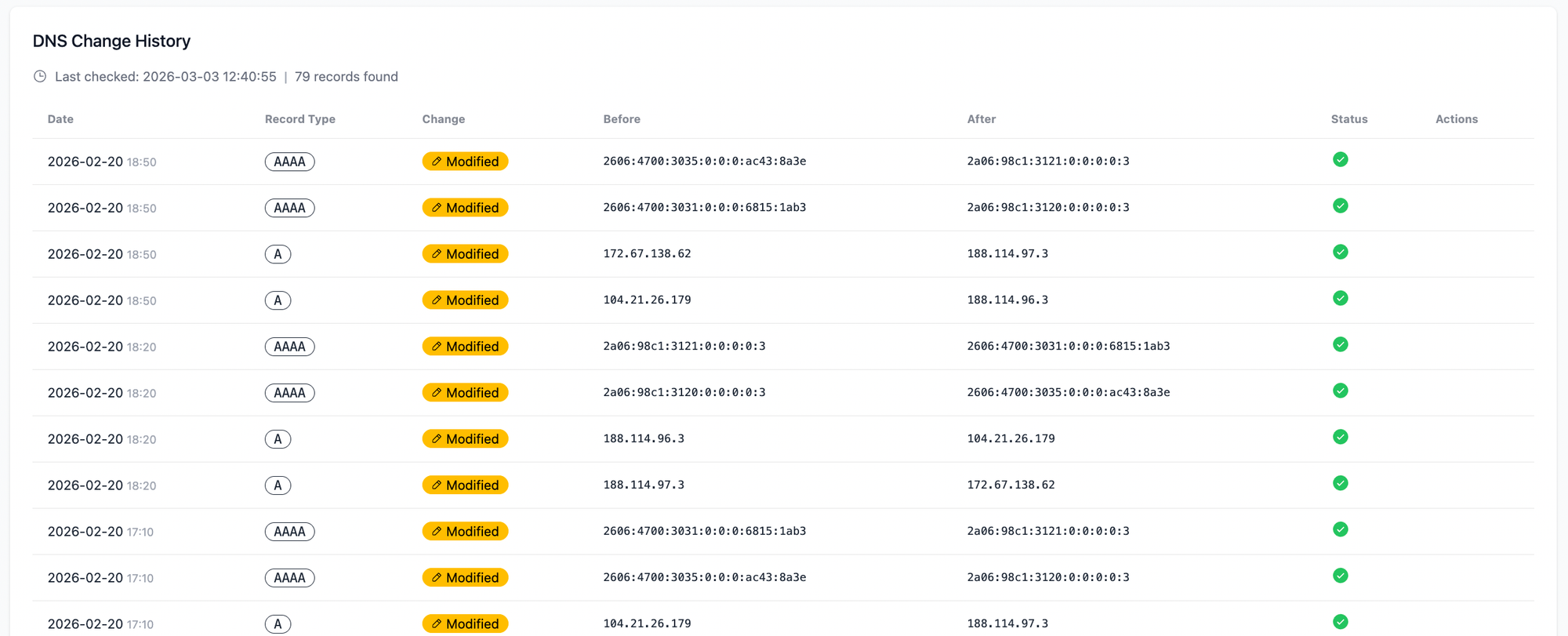
Client-side errors are the #1 cause of campaign downtime. Often, a client’s IT department will update their corporate DNS settings without realizing it breaks a marketing subdomain.
Professional domain monitoring for marketing agencies must include real-time tracking of MX and NS records. By monitoring these "Golden Records," you catch unauthorized changes or accidental deletions the moment they happen - not when the client calls you to ask why the leads have stopped.
Pillar 2: SSL Handshake Validation
Don't just check the expiration date on a certificate. You must verify the "Chain of Trust." Many automated SSL tools (like Let's Encrypt) fail during renewal due to temporary DNS validation errors or server-side rate limits.
Daily handshake checks ensure that your certificates are correctly installed and accessible on all devices (including older mobile browsers). This protects your client's ad spend from being wasted on "Insecure Connection" pages.
Pillar 3: Centralized Alerting via Slack or Telegram
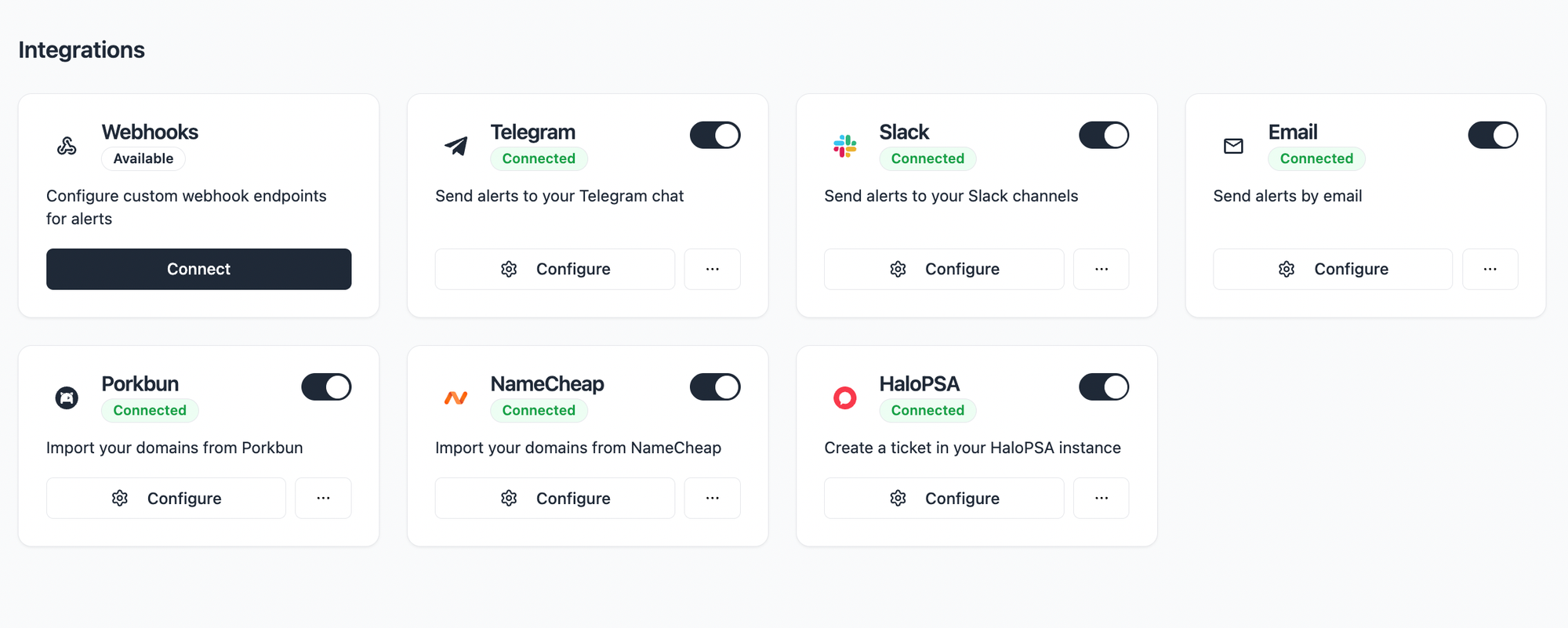
In a fast-paced agency environment, email is where notifications go to die. For an effective agency domain management tool, alerts should be pushed to the platforms where the team actually communicates.
Pushing high-priority domain alerts to a dedicated Slack channel ensures that technical glitches are seen by the whole team, allowing for a resolution within minutes.
Pillar 4: Financial Planning with Renewal Calendars
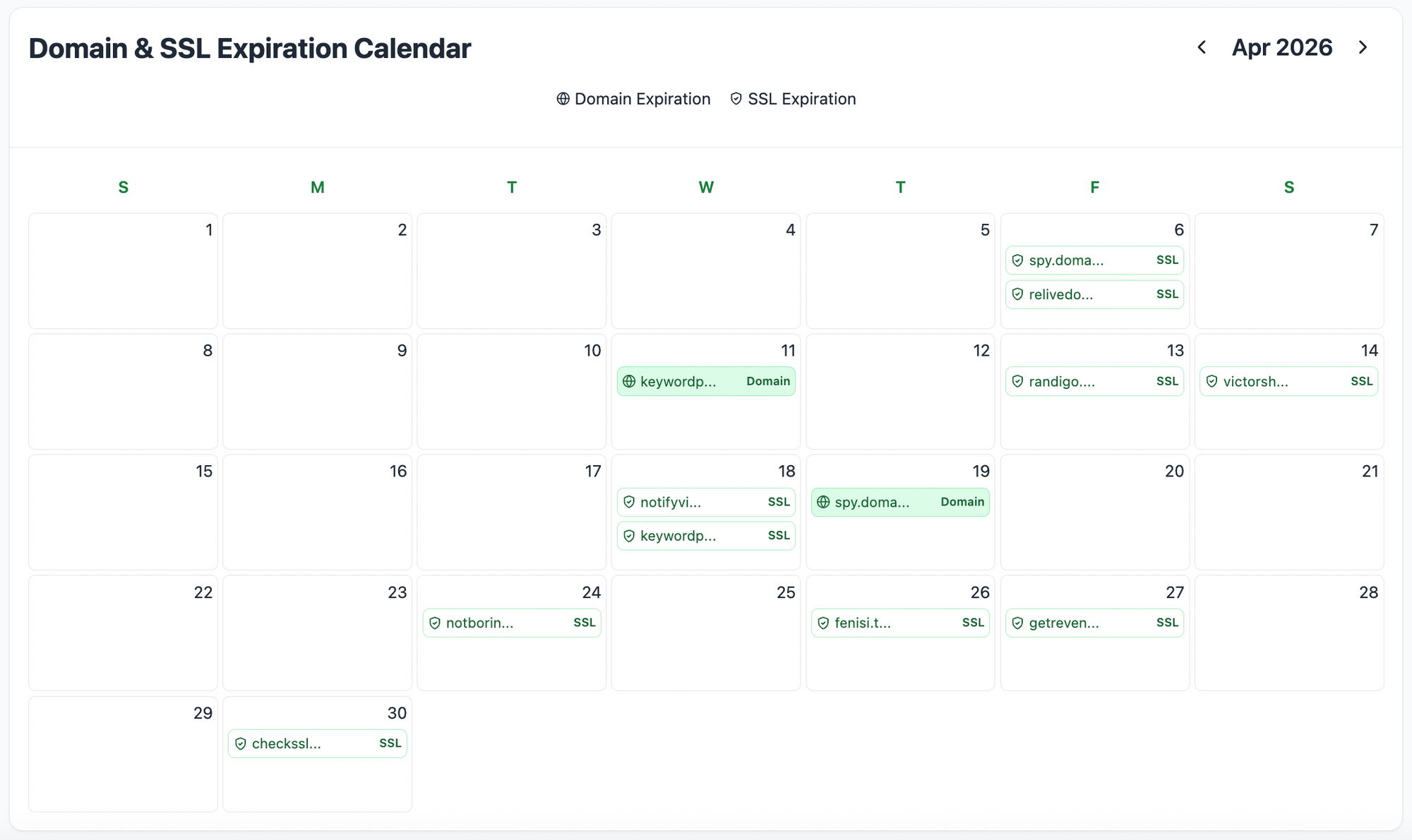
Domain management isn't just a technical task; it's a financial one. Using a visual Renewal Calendar allows your account managers to forecast upcoming costs for their clients. Proactively telling a client, "Your three campaign domains are renewing next month; please ensure the company card is funded," adds a layer of professional value that clients appreciate.
Scaling Your Infrastructure with KIT.domains
While there are many manual ways to manage assets, KIT.domains was specifically engineered to handle the complexities of domain monitoring for marketing agencies. It acts as an automated "DevOps assistant," allowing your team to focus on creative strategy rather than technical housekeeping.
Unified Dashboard: One Screen, All Registrars
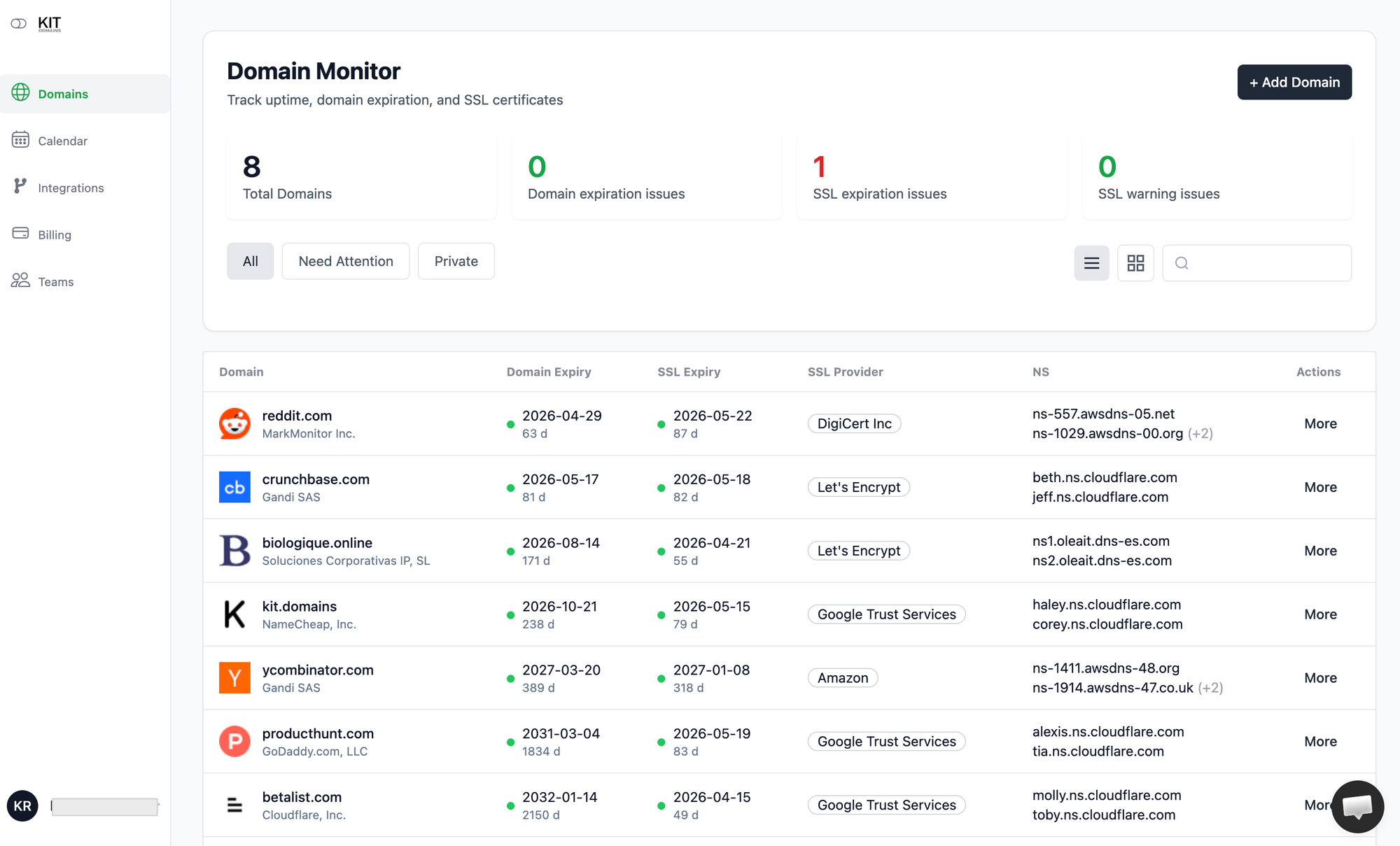
KIT.domains solves the "provider sprawl" problem by aggregating all your client assets into one clean view. Whether a domain is on GoDaddy, Namecheap, or Route53, you see it in the same dashboard.
Registry-Level Accuracy
We don't rely on registrar dashboards, which can sometimes be delayed. We verify dates via official WHOIS records to track domain expiration for clients with absolute precision.
Integrated DNS & SSL Monitoring
We monitor the function, not just the date. If a DNS record shifts or an SSL handshake fails, KIT.domains triggers an instant ping. This is infrastructure observability designed for the needs of performance marketers.
Workflow Automation: Bulk Import & API
Adding 100+ client domains shouldn't take all morning. With our Bulk Import tool and developer-friendly API, KIT.domains fits seamlessly into the modern agency stack, from onboarding to daily reporting.
Frequently Asked Questions (FAQ)
💡 What is the most reliable way to monitor client domains?
The best method is to use a dedicated agency domain management tool that centralizes all assets into one dashboard and uses registry-level data (WHOIS) to avoid registrar-side errors.
💡 Why should an agency track domain expiration for clients?
If a domain expires, ad campaigns stop, and SEO rankings drop. By taking control of the monitoring, the agency protects the client's ROI and secures its own reputation as a proactive partner.
💡 Can I monitor domains from multiple registrars in one place?
Yes. Professional platforms for domain monitoring for marketing agencies are registrar-agnostic, allowing you to track domains from GoDaddy, Namecheap, and others in a single interface.
💡 How does DNS monitoring prevent "traffic leakage"?
If a DNS record points to a broken server or is misconfigured, your ads will drive traffic to a dead link. DNS Integrity Monitoring alerts you to these changes instantly so you can pause ad spend before money is wasted.
Conclusion: Focus on ROAS, Not Records
In the digital marketing industry, your reputation is built on results. By implementing professional domain monitoring for marketing agencies, you remove a massive point of failure from your operations.
Stop wasting billable hours on manual checks and start using an agency domain management tool that gives you the peace of mind to focus on what you do best: driving growth for your clients.
Start your 14-day free trial at KIT.domains and secure your client portfolio today!